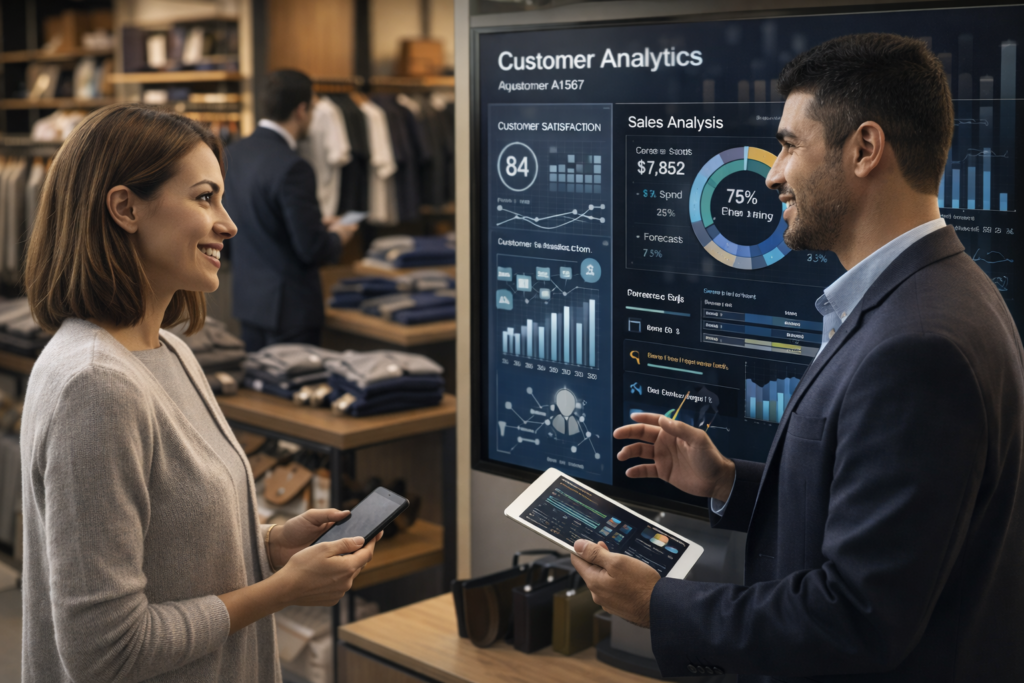
From Enhancing Customer Experience to Redefining the Entire Business Model
Artificial intelligence in the retail sector is no longer merely a technological tool for improving customer service. It has become a strategic pillar that is reshaping how retail businesses operate at their core. What we are witnessing today is not incremental improvement, but a transition from intuition-driven decision-making to a data-centric model powered by predictive analytics and real-time AI-driven insights.
According to reports by McKinsey & Company, organizations that effectively adopt advanced analytics and AI-driven personalization can increase revenues by 5% to 15%, while simultaneously improving marketing efficiency and reducing operational costs. In retail specifically, personalization has become a decisive factor in boosting conversion rates and increasing average basket value.
Customer Experience Is No Longer a Touchpoint — It Is a Data Ecosystem
Modern retail customer journeys span multiple channels: physical stores, websites, mobile applications, social media platforms, and contact centers. The real challenge lies in unifying these touchpoints into a single, cohesive data view.
This is where platforms such as Salesforce, Oracle CX, and SAP Customer Experience play a crucial role. They consolidate customer data across channels into unified cloud-based architectures, enabling consistent personalization and informed decision-making.
According to Gartner, organizations that successfully centralize customer data within a Customer Data Platform (CDP) significantly enhance their ability to deliver personalized experiences — a capability directly linked to improved loyalty and customer retention metrics.
Operational Impact: From Prediction to Execution
AI in retail operates on two interconnected levels:
Front-End Transformation
On the customer-facing side, AI analyzes browsing behavior, recommends products, personalizes promotions, powers conversational chatbots, and performs sentiment analysis to refine engagement strategies.
Back-End Optimization
On the operational side, AI predicts demand, optimizes inventory management, reduces stockouts, and improves product distribution across branches.
Retail giants such as Walmart leverage predictive analytics to forecast seasonal demand and streamline supply chain operations. Industry studies indicate that AI-driven forecasting can improve inventory accuracy by 30% to 35% and reduce stockouts by 15% to 25%.
Customer Service: Lower Costs, Higher Quality
Within contact centers, platforms like Genesys and NICE integrate AI for intelligent call routing, voice sentiment analysis, and automated assistance.
Published case studies report:
- 15% to 30% reduction in Average Handling Time (AHT)
- Up to 20-point improvement in Customer Satisfaction (CSAT)
- Up to 30% reduction in cost per interaction
These outcomes demonstrate that AI enhances both customer experience quality and operational efficiency.
The Direct Link Between AI and Profitability
A Forrester Research report highlights that investment in customer experience directly correlates with increased retention and improved Customer Lifetime Value (CLV). In retail, even marginal improvements in retention can significantly increase profitability, as the cost of retaining customers is considerably lower than acquiring new ones.
AI-driven personalization not only improves conversion rates but also increases average basket size through data-driven product recommendations based on prior purchase behavior.
Technical Architecture: What Successful Integration Requires
A successful AI deployment in retail demands:
- Integration between POS systems and CRM platforms
- Synchronization of e-commerce platforms with centralized data warehouses
- Cloud infrastructure (Azure, AWS, or similar platforms) to host AI models
- A unified data warehouse environment
- Strong data governance frameworks
Without cohesive and high-quality data infrastructure, AI loses its strategic value.
Risks of Poor Implementation
Despite its potential, AI implementation carries risks:
- Fragmented legacy systems
- Poor data quality
- Over-automation without human oversight
- Privacy and regulatory compliance concerns
Gartner reports that many AI initiatives fail not due to technological limitations, but because of weak governance, unclear objectives, and insufficient change management
The Future of Retail
The next wave of retail transformation extends beyond service enhancement. It encompasses smart stores, dynamic pricing, frictionless checkout systems, and real-time in-store personalization — all powered by advanced AI layers operating behind the scenes.
Retailers that embed AI into a clearly defined business strategy — rather than treating it as an isolated IT initiative — will secure sustainable competitive advantage.
Executive Conclusion
Artificial intelligence in retail is no longer experimental; it is foundational.
It drives:
- Revenue growth
- Operational efficiency
- Cost reduction
- Customer loyalty
- Long-term profitability
The true differentiator is not merely owning the technology, but integrating it within a data-driven business model supported by governance, strategic alignment, and continuous optimization.